Georg Simmel and the Disciplinary Imaginary by Goodstein Elizabeth S
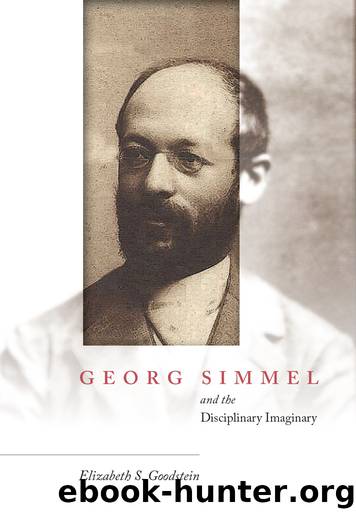
Author:Goodstein, Elizabeth S. [Goodstein, Elizabeth S.]
Language: eng
Format: epub
Publisher: Stanford University Press
Published: 2016-04-14T16:00:00+00:00
Money, Representation, and “the Cultural Process”
In (re)turning to philosophy, Simmel had neither left the empirical-sociological dimension behind nor sundered theory from (knowledge) praxis. On the contrary, he was attempting to integrate a renewed engagement with everyday experience into philosophy. In the historical life of society, relativity becomes concrete. What Simmel later called his “special concept of metaphysics,” in which “relativism as a cosmic and epistemic principle that replaces the substantial and abstract unity of the world-image with the organic unity of reciprocal interaction” (GSG 20: 305), finds its model in money.
For Simmel, “relativism” functions both as a phenomenological description and as a theoretical account of the relations between social-historical and cultural phenomena and epistemological and metaphysical issues. It is neither the embrace of a generalized contextualism nor an admission of defeat in the face of the apparent “dissolution of everything substantial, absolute, eternal” in modernity. As he described it in the Preface to the Philosophy of Money, Simmel’s “fundamental intention from a methodological point of view” was to “build a story beneath historical materialism” that captured the indeterminacy of reality by upholding idealist and materialist perspectives in unending dialectical exchange. On his view, “In such alternation and absorption of completely opposed cognitive principles, the unity of things, which appears ungraspable to our cognition and nevertheless grounds its complexity, is rendered practical and animated for us” (13).
Money is the incorporation of relativity as such and as such a dialectical phenomenon that fosters both sides of every opposition it enters. Thus it brings what is far near, near, far; intensifies subjectivity and renders objects more independent, and so on. Money is, as it were, both synthetic and analytic: as a historical phenomenon, even as it facilitates the emergence of larger and more complex forms of social and cultural organization, money also brings about all sorts of fragmentation, notably the breakdown of the long-standing, inherited “forms of life” that had circumscribed human existence in traditional society and thereby stabilized its meaning. Such desubstantializing developments are culturally and historically but also psychologically and metaphysically significant: focusing on money’s dialectical effects makes visible the complex interplay between the material and ideal transformations under way in what would come to be called the modernization process.
For example, Simmel reads the increasing importance of money in economic life beginning in what we would now call the early modern period as both a symptom and a catalyst of the decline of landed property and the socially fixed forms of human self-understanding that marked premodern identities. The gradual emergence of industrial capital, that is to say, of a form of wealth radically separable from its origins, went hand in hand with the destabilization of the dominant politico-religious framework of the medieval world, itself fostered and intensified by the rise of “natural” philosophy. Urbanization and industrialization (and, we would add, colonialism) furthered and internationalized the ongoing reorganization of social and cultural life that the ascent of the globalized money economy and its increasing penetration into all life spheres both symbolizes and fosters.
Download
This site does not store any files on its server. We only index and link to content provided by other sites. Please contact the content providers to delete copyright contents if any and email us, we'll remove relevant links or contents immediately.
| Africa | Americas |
| Arctic & Antarctica | Asia |
| Australia & Oceania | Europe |
| Middle East | Russia |
| United States | World |
| Ancient Civilizations | Military |
| Historical Study & Educational Resources |
Room 212 by Kate Stewart(5130)
The Crown by Robert Lacey(4820)
Endurance: Shackleton's Incredible Voyage by Alfred Lansing(4788)
The Iron Duke by The Iron Duke(4367)
The Rape of Nanking by Iris Chang(4224)
Joan of Arc by Mary Gordon(4117)
Killing England by Bill O'Reilly(4008)
Say Nothing by Patrick Radden Keefe(3991)
I'll Give You the Sun by Jandy Nelson(3451)
Shadow of Night by Deborah Harkness(3377)
Hitler's Monsters by Eric Kurlander(3348)
Mary, Queen of Scots, and the Murder of Lord Darnley by Alison Weir(3215)
Blood and Sand by Alex Von Tunzelmann(3207)
Eleanor & Park by Rainbow Rowell(3185)
Darkest Hour by Anthony McCarten(3135)
Margaret Thatcher: The Autobiography by Thatcher Margaret(3087)
Book of Life by Deborah Harkness(2943)
Red Famine: Stalin's War on Ukraine by Anne Applebaum(2940)
The One Memory of Flora Banks by Emily Barr(2870)
